
Italian Cinema Audiences – Real Stories by Real People
Published
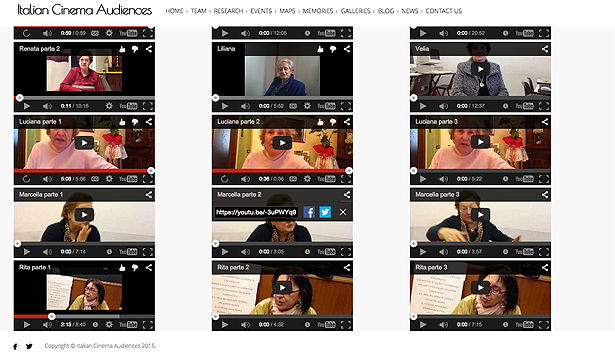
In this post, I am not going to discuss a particular film but share with you a very special project I came across the other day.
I’d like to give the discovery credit to my favorite Twitter hashtags – we all have our own lists – that keep me abreast about the greatest and latest news in Italian cinema. In my list, you will find the typical suspects of Italian filmmakers, film fests, distribution companies and special influencers – all focusing on the business of cinema, and primarily – the directors and stars that are front and center.
That’s why I was very enthralled to come across an exciting research project called “Italian Cinema Audiences” that takes the focus away from the stars and directors – but tracing the imprints of cinema-going experience through the eyes of non-expert audiences who experienced the films first hand in Italy of the 40s-50s.
Now that’s innovative! The project is led by Daniela Treveri Gennari (Oxford Brookes University), Catherine O’Rawe (University of Bristol) and Danielle Hipkins (University of Exeter), and funded by the Arts and Humanities Research Council (AHRC).
This unique angle resonated with me on several levels. First, audiences’ perspectives are typically ignored. In the US, you may have heard about major studios running focus groups before a movie release to gauge success, weekend box office results, or occasional interviews of viewers’ impressions as they leave the theater. In large, audiences are treated as a faceless amalgam of data.
And just to balance the picture, with the emergence of social media there is also a counter trend that democratizes the voice of audiences in shaping a buzz around released films – including personal movie blogs like this one that provide an open mic for movie fans to express their views.
That’s why I think Italian Cinema Audiences is important. Through a myriad of video interviews it captures first-hand testimonials of audiences who experienced cinema growing up in Italy’s 40s and 50s – real stories by real people, recreating maps of their movie theaters, common norms of the time (e.g., women did not go alone to the movies), and entertainment habits.
Second, I like peeking into the perspective of non-expert audiences. It reminds me of Ermanno Olmi’s comments about the importance of facial expressions in his 1962 film Il Posto – The Job. Committed to the Neorealism genre, he preferred working with non-professional actors in their genuine environment – the only way to extract the most authentic acting, as they played themselves.
Third, I liked that the video interviews revealed a clear preference for American films over Italian ones during the 40s–50s. One lady, Natalia, said that at the time she didn’t like Neorealism much, as it created bad publicity about Italy by focusing on poverty and social injustice – later she learned to appreciate these films’ importance.
I would love to see this research turned into a documentary that frames these authentic video interviews within historic footage – news media and films of the era – juxtaposing actual historical facts against time-capsule human stories of the people who lived through them.
To hop on this time machine, you can start by watching the available video interviews (all in Italian – hopefully English subtitles will be added). More interviews will be released later this year, and I plan to feature a few of the most interesting testimonials here and on our social networks. Stay tuned!
