Archive for February, 2008

Published by Shlomi Ron on 26 Feb 2008

Bicycle Thieves - Ladri di biciclette (Vittorio De Sica – 1948)

Bicycle Thieves

Stories about the common man emphasizing social issues, scenes shot in actual locations, and the use of non-professional actors – are the key ingredients of the Neorealist film movement in postwar Italy, which this film is one of its prominent expressions.

Directed by Vittorio De Sica and adapted for the screen by Cesare Zavattini based loosely on the novel by Luigi Bartolini, the film tells a simple story. A man’s bicycle gets stolen and he looks for them. No wonder De Sica had difficulties to finance the film. You might say it’s a film about nothing.

Yet, there is so much more.

De Sica vividly paints a reality of dire economic conditions with consistent use of crowds in various contexts; fighting to get a job in the opening scene, in an endless line at the bus station, leaving a stadium, and waiting for a piece of bread at the church. Everything seems like a huge struggle. So against this backdrop of rough settings, even the sense of finally finding a job comes with a catch. Antonio, played beautifully by Lamberto Maggiorani, needs to have a bicycle in order to get the job. His wife (Lianella Carell) figures out a way to get back their pawned bicycle and off he goes on his first day on the job.

The scene of swarms of morning commuters either on bicycles, on foot or on overflowing buses pans nicely to Antonio’s facial expression of pride of being able to provide for his family – is very strong. Against all odds he overcame all obstacles and found a way to make a living.

Finding a job, and figuring out a way to keep it are key elements De Sica uses in order to substantiate the buildup of the accomplishment and the earth shattering sensation when this precious locomotive is being stolen the next day, thus crumbling Antonio’s aspirations for a better future. Emotions of deep haplessness and loneliness bring out powerful performances from father and son – two non-professional actors that could have probably experienced such predicaments in their personal lives.

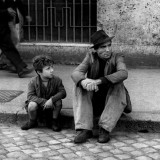
Bicycle ThievesAntonio and his son Bruno (Enzo Staiola) are then thrown into an impossible quest of finding the bicycle somewhere around Rome. The father-son relationship throughout this journey is a rare examination of weighing priorities; finding the bicycles, the key to survival or recognizing the son’s needs as extenuated in the river scene.

The message of the film is clear. No matter how low you sink, the unconditional bonds you have with your loved ones should override any external threats.

> Buy this film

Published by Shlomi Ron on 03 Feb 2008

Tickets (Ermanno Olmi, Abbas Kiarostami, Ken Loach - 2005)

You better leave now if you want to catch this train.

If we do a good job for this worldwide company, we’ll be on the gravy train for more projects.

Sorry, for this class the train has already left the station - registration is over.

Thanks, but you’ve just interrupted my train of thoughts.

ticketsTrains offer a rich canvas for conveying many human contexts, challenges, disappointments and hopes. So it’s only natural that cinema would utilize this eclectic locomotive in various ways. And indeed, trains and train stations play a highly emotional role in Italian cinema and beyond. The dramatic sense of departure between loved ones towards the unknown future (I Vitelloni, Federico Fellini - 1953), the arrival to a new place and the constant search for the ever-waiting relative (Rocco and his Brothers – Luchino Visconti - 1960) – and many more.

Whereas in most films the train environment appears only in a few scenes to underscore a particular emotional development, then in this film the train is brought front and center and functions as the constant backdrop for the plot throughout the whole film.

Moreover, this film provide a cross-cultural triptych of three prominent directors;tickets Ermanno Olmi (Italy), Abbas Kiarostami (Iran), and Ken Loach (Britain). Each brings his own artistic sensibilities to weave a story with characters riding the train from central Europe to Rome. The beauty of the film is how these characters transition from one story driven by one director to another. For that matter, it’s definitely worth viewing the Behind the Scenes bonus content to appreciate the careful planning that was involved in weaving these three independent plots into one cohesive artwork.

Often trains’ linear nature represent a metaphor for life’s winding rail where each station is another milestone en route to a final destination, that once accomplished nirvana supposedly descends. The same logic is also apparent in this film where Olmi, leveraging his signature style of using present to past flashbacks (see The Enagaged - I Fidanzati – 1963), Kiarostami by creating a somber brooding mood about past events and Loach by planting series of human miscommunications that unravel upon arrival to Rome.

No doubt, trains are vibrant microcosms where ephemeral human stories are produced every day. Think about it the next time you ride the train…

>Buy this film