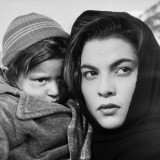
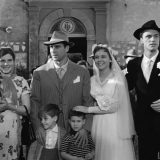
Mamma Roma (Pier Paolo Pasolini – 1962)

Individualism vs. determinism is it truly up to the individual to change his destiny or is it all predetermined?

Anna Magnani in Mamma Roma (Pier Paolo Pasolini - 1962)
Anna Magnani in an emotion explosion

In his second film Mamma Roma, Pier Paolo Pasolini is constantly moving between these two extreme poles. The story, brings about Pasolini’s typical characters on the margins of life as skillfully represented by the role of Anna Magnani, a Roman prostitute that tries hard to do a career change and at the same time ensure a better life for her son. Some say, Pasolini is in fact using Mamma Roma as analogy to all Italy, by putting a blaming finger to the responsibility of the state and the church that abandoned the struggling poor.

In some aspects, you may find typical themes to Pasolini’s first film Accatone. In both films Sergio Citti plays a local pimp who tries in vein to better his poor existence in Rome’s slums. The Neorealist rough reality in both films is brought up into an epic expression, as if to say: nothing’s new here this is an eternal human condition – by using classic music as soundtrack: Bach in Accatone and Vivaldi in Mamma Roma.

The Last Supper - Leonardo Da VinciThe Last Supper by Leonardo Da Vinci

Mamma Roma (Pier Paolo Pasolini - 1962)Pasolini’s opening scene in Mamma Roma

Another technique to amplify the epic portrayal of the characters is the strong visual influence from classic artworks such as the first scene positioned as The Last Supper by Leonardo Da Vinci; or when Ettore, strapped in his bed, is closely expressed as Andrea Mantegna’s The Lamentation over the Dead Christ.

The Lamentation over the Dead Christ - Andrea MantegnaThe Lamentation over the Dead Christ
by Andrea Mantegna

Mamma Roma (Pier Paolo Pasolini - 1962)Ettore Garofolo in Pasolini’s Mamma Roma

I especially liked the night scenes where Anna Magani is shown walking the dark road and brisk encounters with clients, friends, are woven into her long monolog. I found these scenes as an allegory to life itself (road of life) and the attempt to make sense of it despite the pitfalls.

The son, Ettore (Ettore Garofolo) brings about an authentic portrayal of a son who grew up away from his mother and they both meet again in his teens, he tries hard to both understand his mother as well as rebel and find his voice. Interestingly, because of the detachment, Mamma Roma (Magnani) still tries to compensate for lost years and treat him as a young boy, if you consider that scene where Ettore is shown riding a carousel with Mamma Roma watching.

Looking outside the film, we know that Pasolini had a very close relationship with his mother; and within this context you could interpret some of the mother-son scenes such as the dance scene as quite on the intimate side.

Throughout the film you will see three visual signifiers: the open fields, the new white buildings and the ruins of old aqueducts. These elements help paint a picture of a society in transition from old to new, from Roman waterways that provided life to the city – to ruins indicating figurative death represented by the lifeless white buildings and the new gospel of consumerism Pasolini fought hard against.

The film brings about a simple message of human basic need to create a better future despite reality’s constant constraints. If it was a direct route to success for everybody then: a) sense of accomplishment will be lost and every action will become a habit with a predicted outcome b) movies will lose their conflict-driven storyline and become banal and c) you tell me?

Buy this movie

>Join Netflix and get unlimited movies! Instantly streaming to your TV.

Giulia non esce la sera – Giulia Doesn’t Date at Night (Giuseppe Piccioni – 2009)

In this film Giuseppe Piccioni returns to familiar themes of alienation and the decline of modern family structures, the resulting need for companionship and our value system that wraps it all in good and bad labels.

Giulia non esce la sera - Giulia Doesn't Date at Night (2009)The film’s 3 protagonists: Giulia, Guido and their swimming pool

The film runs 3 main parallel plot lines: the semi-successful writing career of Guido (Valerio Mastandrea), his deteriorating family structure until separation from his wife and daughter, the encounter of Guido with Giulia (Valeria Golino) – his daughter’s swimming instructor by day and as later revealed – a prison inmate by night. Hence, the movie title “Giulia non esce la sera – Giulia Doesn’t Date at Night”

As the relationship develops between Giulia and Guido, mostly emanating from the personal swimming classes Giulia provides Guido, Picconi vividly shows us the clear fault lines around us. In one of the many swimming pool scenes, Giulia brings Guido underwater to see the world from an unusual point of view – a wondrous twilight zone where all people are the same as they try to negotiate their way in the water.

The tables are radically turned when Guido needs to face questions about her past and fulfill her prison parole duties – off water. Confronted with Guido’s harsh prison reality and the reason why she ended up behind bars, you begin to realize that the swimming pool is Giulia’s only salvage, the only place where she can command control on others and at the same time can take stoke on her life from afar.

I especially liked Giulia’s blank facial expressions as she holds in her true story and how difficult it is to break down her defense walls she had built to fend off past ordeals from reappearing or new relationships with Guido to easily exist. True, it’s a natural survival instinct to learn from the past, however sometimes at the risk of generalizing and missing out on truly solid opportunities to connect and grow.

Some memorable visual signifiers include: the half vacated apartment Guido lives in, an effective internal representation of his life after his wife and daughter left him; the recurring appearance of the windows’ white shades the wind blows, which seems to indicate that winds of change are coming; and the numerous swimming pool scenes, signifying as mentioned above, an alternate reality, that also plays as the unassuming context/pretext for the relationship between Giulia and Guido to develop.

YouTube Preview Image
Piangi Roma – Cry Rome: Theme song by Bausetelle

As viewer, the film takes you on a journey where some elements are gradually revealed about its protagonists; a conflict is detected, solution is attempted sending rings of impact on sub-plots – packaged nicely with the emotive theme soundtrack by Baustelle, sung in part by Valeria Goilino. Beautiful!

>Join Netflix and get unlimited movies! Instantly streaming to your TV.

>Buy this film


Passione (John Turturro – 2010)

23 songs shot in 21 days would be the skinniest premise for an otherwise very passionate musical journey by John Turturro into the cultural alleys and pathways of a very special city – Napoli.

YouTube Preview ImageTrailer

I attended the film uptown opening, at The Film Society of Lincoln Center’s new state-of-the-art Elinor Bunin Munroe Film Center in New York where the screening also followed a Q&A with actor and director John Turturro (see video clip below). Indeed, a very sleek space that truly deserves its consistent appeal as the “mecca” for cinefiles.

The film opens with a personal introduction by Turturro among other comments peppered throughout the film. Turturro later revealed his narration was an advice he received from Francesco Rosi who also had directed him as Primo Levi in 1997 La Tregua – The Truce. I can’t argue with Maestro Rosi, but personally, I would have preferred to leave this English narration out, as it takes away from the pure authenticity of the spoken Napolitan dialect and music. In those instances, I felt the film unjustly turns into a Travel Channel segment.

Turturro follows a tried-and-true template that was formerly christened by Wim Wenders’s 1999 Buena Vista Social Club with similar ingredients: authentic location, archival footage, and phenomenal homegrown music performed by unknown yet gifted musicians that tell their rough life stories between songs. Someone in the audience later labeled this film as “music neorealism” which I found interesting.

Passione (John Turturro – 2010)
Reggae-styled Nun te scurda’ performed by Almamegretta, Raiz,
Pietra Montecorvino & M’Barka Ben Taleb

You will find here some of the classic Neapolitan masterpieces such as Maruzzella by Renato Carosone with a striking performance on Napoli’s beach of all places by Gennaro Cosmo Parlato; O Sole Mio featuring legendary opera singer Enrico Caruso among less known but emotionally charged songs like Passione performed by James Senese. You can totally believe Senese’s bluesy delivery especially when he earlier recounts his challenging childhood in Napoli as a son of a black American solider whom he never met and a local girl.

An interesting anecdote, during my recent vacation to Napa Valley, I made the day for a friendly Napolitan bar tender in a wine tasting room after showing him the song list. So I guess these songs are considered gold standard even by the natives.

The film also includes archival footage from Istituto Luce, showcasing post-World War II Napoli: the people, their hardships, the American liberation and most of all the music as a powerful thread to the present that keep Napolitans alive. From this perspective the songs represent Napoli’s history of being conquered so many times, resulting in an eclectic ethnic collage.

Turturro’s as an Italian-American (half Sicilian half Pugliese) consciously decided not to show the pretty touristic image of Napoli and instead focused more on the evocative Napolitan reality as evidenced by singers and locals. In this sense, the film represents his personal journey into Napoli’s rich musical culture anchored around the past with WWII American liberation and its impact on locals and the present with its eclectic music scene. As such, the film nicely closes an identity loop with a global truth: know where you came from.

The big message the film eloquently delivers is simple. Music unlike any art form is about that special and direct dialog it has with the audience that goes beyond language, manipulative plots, director intent, history or any other external layers. At the end of the day, it’s all about this precious interplay between the audience personal experiences and the music. I found the music fairly contagious, so be ware.

I leave you with the post-screening discussion between Actor and director John Turturro and Italian journalist Andrea Visconti at Lincoln Center:

YouTube Preview Image

Join Netflix and get unlimited movies! Instantly streaming to your TV.

>Buy Film Soundtrack

Fughe e approdi – Return to the Aeolian Islands (Giovanna Taviani – 2010)

Quick, what comes to your mind when you think about the word “island?”

It’s not a coincidence the word swings between two opposing associations: on the positive end, it offers exotic escape, away from it all repose, while on the negative – a sense of forced seclusion, and disconnectedness from rest of the world.

The same duality we find in Giovanna Taviani’s latest and charming documentary I had the opportunity to catch last week at Open Roads: New Italian Cinema, a festival hosted by Lincoln Film Society in New York. In fact, the film’s original title explicitly expresses this duality: Fughe e approdi (Escapes and Shores).

But first, a bit of context: in order to fully appreciate this film, you need to know that the lead role in this film is marvelously played by the Aeolian islands (volcanic archipelago in the Tyrrhenian Sea north of Sicily). The islands serve the settings for both the personal story of the director, growing up in the island of Salina, and for myriad stories told by the islanders that hosted some of the most prominent cinematic gems shot there from early 40’s until the present. From this perspective, the film is truly an ode for the Aeolian islands and their remarkable cultural and political history.

Second, Giovanna Taviani, is the daughter of Vittorio Taviani of the famed Brothers Taviani and was featured as little girl in their masterpiece Kaos (Paolo and Vittorio Taviani -1984). So growing up in the island of Salina, being the daughter of, and participating in this iconic film – provide effective themes to weave the story of the Aeolian islands from a very personal perspective of a director that attempts, and in my opinion, succeeds in finding her own cinematic voice despite her privileged background.

And that’s tough.

Fughe e approdi - Return to the Aeolian Islands (Giovanna Taviani – 2010)
Original boat and fisherman from Brothers Taviani’s 1984 Kaos
as a narrative bridge between space and time

Taviani demonstrates a skillful storytelling strategy by using several personal anchors such as personally narrating the film (almost as vocal diary), and the use of the original boat and fisherman Franco Figlio d’oro from Kaos. I especially liked the way Taviani is in fact taking the audience on a majestic voyage both in space: having the red sailed boat as scene connector, hopping from island to island – and time: the occasionally humorous interviews with the islanders and archive footage to bring historical and cinematic events to life.

Beyond the personal aspects, the film provides a highly educational review of some of the most important historical events associated with the islands such as the confinement and escape of anti-fascists Carlo Rosselli and Emilio Lussu from the island of Lipari and slew of cinematic masterpieces shot on the islands. From mid- 40’s, the pioneering work of Alliata, Maraini and Moncada who founded Panaria Film, historical production company that produced Italy’s first submarine documentaries, 1954’s Isole di fuoco (islands of Fire) by Vittorio De Seta – to more renowned films by Antonioni with “L’avventura”, Rossellini with 1950’s “Stromboli” featuring Ingrid Bergman on the island of Stromboli and the ensuing volcanic scandal of Anna Magnani, offended by Rossellini’s breaking up with her for Bergman, and as result shooting “Vulcano” on a nearby island; 1993’s Dear Diary (Caro diario) by Nanni Moretti and Massimo Troisi in 1993’s Il Postino – to name a few.

YouTube Preview Image
The film original trailer

As I watched the film, I experienced this unique blend of the wildness of the islands with their volcanic eruptions and historic rough times they inflicted on islanders, but at the same time – the islands’ sheer and intoxicating beauty as magnet for the greatest Italian cinema directors. I guess, I am a little biased since I visited the Aeolian Islands exactly a year ago and the place is indeed beautifully inspiring: the conquer and perseverance of the human spirit over the forces of nature.

Taviani represents a new generation of documentarists that is not only charting her own path but also paving the road for other directors to follow and get exposure. As such Taviani ideated and is the artistic director of SalinaDocFest – an international documentary festival, that after reading the above – you can easily appreciate why it takes place on the island of Salina. I’d love to go back and attend the festival this coming September. We’ll see. But for now, I leave you with a wonderful interview i-Italy.org has recently conducted with Giovanna Taviani.

And as always, don’t take my word for it make it your own experience.

1860 I Mille di Garibaldi (Alessandro Blasetti – 1934)

As Italy celebrates its 150th year of unification (aka Risoregimento) this year, the Lincoln Film Society in New York chose to include this masterpiece by Alessandro Blasetti as part of their current festival: Open Roads: New Italian Cinema. I attended the screening and here are some of my impressions.

1860 I Mille di Garibaldi (Alessandro Blasetti – 1934)
Carmelo and Rosuzza his wife reunited against the backdrop of Italian Unification events: individual vs. collective story lines.

Blasetti known for other historical epics, takes the opportunity to tell the story of Italy’s unification from a personal point of view of a Sicilian patriot named Carmelo (Giuseppe Gulino) on a mission to reach Garibaldi’s headquarters in Genoa and get his help to rescue Sicily from the occupying Spanish Bourbons and German mercenaries. On his way, Carmelo runs into various Italian characters representing different dialects and views regarding the boiling political climate.

The film predated the Neorealism genre that typically referred to as starting with Roberto Rossellini’s Roma, città aperta – Rome, Open City (1945). However, you can already see the genre’s key ingredients at play: usage of non-professional actors, movie shot on location, and description of social rough realities from a commoner point of view. Stylistically, this film is a far cry from Blasetti’s light-hearted 1954 Too Bad She’s Bad – Peccato che sia una Canaglia another precursor. This time, to Italian comedy (Commedia all’italiana) genre that formally started in 1958 with Mario Monicelli’s Big Deal on Madonna Street – I Soliti Ignoti. Indeed, an interesting and prescient work evolution.

The camera movement takes a role of inquisitive “embedded journalist-like” that follows the events either as a follower of Carmelo on his journey, but also as an objective spectator of historical events such as the panoramic battlefield scenes. I especially liked the opening scene where you can see a close up behind window bars and then zooming out to reveal the context of a Sicilian village under rough Bourbon occupation – a simple, yet a powerful way to express the state of imprisonment.

The screening followed by panel discussion with Professors Alexander Stille and Stefano Albertini, and director Mario Martone. Here are a few pointers I found interesting:

  • Director Mario Martone: His film Noi Credevamo – We Believed (2010) was also shown in the festival and provided a modern view of Risoregimento through the personal story of three friends joining activist Giuseppe Mazzini’s political movement (Giovine Italia) and the impact on their lives afterwards. Overall, there are not many films about Italy’s unification. Blasetti in this film is rather unique by explicitly conveying the brutality and physical rough aspects of the period, woven through a personal story. This technique makes the historical event more believable as viewers have tangible “real-life handles” to relate to.
  • Prof. Albertini: The film is not about Garibaldi, in fact we don’t see him much throughout the film; only the facial reactions of soldiers listening to him speak. With that, Blasetti’s message is simple: The Risoregimento (Italy’s unification) was not about the larger than life leaders, it was about real people, with real stories that despite their cultural differences joined forces. This message of unity is interesting to examine against today’s Italian politics, where the separatist Northern League party for example refuses to celebrate the unification and sees it as a waste of money. Another difference, back in the 60’s Italians did not celebrate unification with flags, as it was frowned upon as radical, whereas in this year’s celebrations flags were widely used.
  • Prof. Stille: Blasetti’s technique keeping Garibaldi’s role at a distance and focusing more on people around him processing his impact, was similarly adapted in Francesco Rosi 1962’s Salvatore Giuliano, the famous Sicilian gangster. It forces the viewers to conjure their own opinion about the renowned personality based on the impact of their emotional projection. The film also carries a gender element as Carmelo’s officer commands him not to move from his post to see his wife he hasn’t seen a month just a few miles away. The officer gives as an example Garibaldi who his wife had died, while he was away to reinforce Carmelo’s obedience and patriotism.

So as you can see this masterpiece has dual historical values: getting you introduced to an important chapter in Italy’s history, while at the same time experiencing initial ingredients of Neorealism – a cardinal chapter in Italy’s and the world’s cinematic history.


>Buy this movie


Puma_English_Banner_125x125_10_19_06 Sierra Club Tips on Home and Style banner 125x125
Instantly watch from thousands of TV episodes & movies streaming from Netflix. Try Netflix for FREE!