Archive for January, 2007

Published by Shlomi Ron on 27 Jan 2007

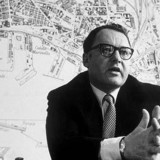
Hands over the City - Le Mani Sulla Città (Francesco Rosi - 1963)

Hands

The characters and events shown are imaginary
The social and environmental
context is real

Fracesco Rosi’s outrageously bold social realism film ends with the above condemning statement. The film offers a unique over the shoulder view into the world of political deal making and corruption in Naples of the early 60’s. Rod Steiger effectively plays the ruthless, power-hungry real-estate speculator that successfully negotiates his way, disregarding needs of the people - in a scandal that has devastated Naples’s civilian landscape.

The film won the 1963 Venice Film Festival Golden Lion and vividly separates the bad guys from the good guys. However, beyond the obvious injustices, it offers a solid reality check. You start looking around you and gradually the picture becomes clearer. We’re all surrounded by outcomes good or bad that are nothing but a direct result of long influence chains of conflicting elements that somehow along the way aligned their interests and negotiated a deal or outcome. It could be your local shopping mall, interest rates, even this computer screen you’re staring at right now. It’s an outcome comprised of a long influence chain: chip suppliers, LCD manufacturer, computer maker, retailers and finally you the consumer - all operating with varying degrees of interests - to negotiate the best deal.

It could have been great if our world had unlimited resources and you could pretty much do anything you like with no consequences on others. Put simply, no losers only winners. Maybe someday when we can completely digitize our physical existence and create a virtual world where you can have endless digital copies of vital resources. Forget Web 2.0, Web millennium anyone? But then again you might say this could be a lonely and somewhat retarded world with no challenges where innovation is stifled.

Nice vision…until then we not only have to play with what we have, but also find ways to do it optimally. Enter Social Economics. The scientific study of the choices made by individuals and societies in regard to the alternative uses of scarce resources, which are employed to satisfy wants. Rosi’s pessimistic view shows how real estate choices in his beloved Naples are ransacked by political and business influence chains, which work only to satisfy their greedy wants. And Piero Piccioni’s erratic music does a superb job to support this premise.

To some extent Rosi’s message is still pertinent today. That said, these days wer’e all part of interconnected social and professional networks with new means of making a bottom-up impact. What influence chains are you playing with and for what outcomes?

>Buy this film

Published by Victor on 23 Jan 2007

Cinema Paradiso (Giuseppe Tornatore - 1988)

Several days ago we saw Cinema Paradiso at the House of Italy. Clearly the film centers on the relationship of projectionist Alfredo with Salvatore (Toto), both as child and as adolescent. A question that always comes back to me is why Alfredo insists so forcefully that the adolescent Salvatore leave and never return and never contact him again. Equally critical is the question why does Salvatore listen to Alfredo.

What precisely is wrong with village life in the Sicilian town that makes Alfredo so determined to force Salvatore out? And what knowledge does he have that somehow Toto shares with him such that Alfredo’s insistence is not personal rejection?

Of course, in the longer version we might say it’s the forbidden crossing of class lines that makes this town seem so backward looking or repressive, but then that version never was the popular one. The popular version does not go into much detail about class lines preventing Salvatores’ romance. And yet here we have Alfredo, on the beach with his quiet but determined friend, for once speaking his own words, insisting Toto leave, never return, never contact him again.

Is this rejection of the Sicilian village and its society simply an anomaly in a film everyone sees as nostalgic? Is this demand that Salvatore never return really a good foundation for what every critic feels is just a feel-good movie about the good old days of glorious film and about the supposedly integrated world that makes our present-day atomised world seem like an alien insane asylum?

Clearly the village we see at the end of the film, Paradise crumbling in preparation for a parking lot, the beautiful piazza now jammed with buses, cars and jumbled arrays of junk, seems to be a paradise lost. So maybe Alfredo was prescient, maybe he saw the end coming. But I don’t think so.

The hard core of this movie is the work done by Alfredo, the projectionist, work that made him central to the village life but work that also destroyed him, an industrial labor that was incidentally infected with the romance of story-telling through pictures. What Alfredo knows is that he is not the one telling the stories and that the romance can be cut out, even if young Toto can conjure it up in single frames in his kitchen. Would Alfredo like to be the story-teller? You bet. That’s what binds Toto and Alfredo. Could he be? Not in a million years, this sweet, enduring peasant. And Toto? What of him? Could he ever grow into a story-teller in this village?

His initial attempts at this story-telling in high school seem perilous and ineffective, more an effort to capture some glimmer of his love, a keepsake of romance, than telling a story of love.

Life in this village, no matter what year, is always going to be edited, class differences will always be enforced, even in Paradise, and Toto will never have the opportunity to tell his own stories. Is this not the story of almost all Italian emigration?

And yet what does Salvatore accomplish by leaving? Is he around to save the Cinema Paradiso? Does he carry with him the places and people he was once so much a part of? He seems to trade in a donkey cart for a huge Mercedes, he seems to have lost most enduring social connections, he does not seem able to maintain a relationship with a woman for any amount of time, or at least not longer than the period between his mother’s phone calls.

This is not really a nostalgic movie. Rather it is an effort to make history somehow knowable. I see it finally as a look at how stories are made and what makes a story-teller. Someone at a very young age, bright, clever, mischievous, daring, tests all the boundaries and discovers that relationships and character can be represented in glorious ways, edited to eliminate some kinds of glory, but ultimately told in ways that make life sit still for a moment and engage in an entirely different kind of work, the work of remaking images, the work of Eros.

And the means for telling a story is what Alfredo gives Toto. The love and affection they share is the recognition each has in the other that stories are essential to their lives and that perhaps there is nothing else they could work at. So Alfredo tolerates the mischief and Toto tolerates the industrial misery so that each can participate in Toto’s education. But Toto, now Salvatore, can not go further in his education in his home town. And Alfredo can not accompany Salvatore in his work because Salvatore will become a story teller and Alfredo will not. Alfredo’s work is done, there on the beach. It is likely, though, that Salvatores’ work can not really begin until he returns home to recognize something important about himself, about his relationships and about his obligations to that part of the past he loved - that story telling is real work not just for the story teller but also for those who come to the story. That without that notion of shared work Salvatore as a director may not be more than the projectionist, simply stuffing someone else’s stories into the film guides. But Salvatore as a director, as a real story teller, may be able to capture something about the meaning of Alfredo’s work and make it as important for others as it was and still is for him.

The movie is not a glorification of the past, nor is it a condemnation of the present. It is about the limits of Toto’s education and the need for Salvatore to finish his own education, not just about his work as a story teller but also about the parts of his life that have been either edited by someone else or unknowingly by him. This is a direction we find elsewhere in Tornatore, but that’s another discussion.

>Buy this film

Published by Shlomi Ron on 21 Jan 2007

Miracle in Milan – Miracolo a Milano (Vittorio de Sica - 1951)

Miracle in Milan

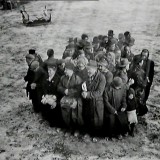
Take a close look at the this picture. What do you think is happening?

A lot has been written about this neorealist modern fairy tale from Vittorio de Sica - the director of ‘The Bicycle Thief’. If you haven’t seen this masterpiece yet, pick one of your gloomy days (we all have a few) and watch it. This heartwarming film is bound to give you the correct perspectives mixed with a great need to do good.

I picked this photo because it effectively illustrates the irony of our modern rat race after fame and money and the inevitable question of how much enough is enough. This especially rings true in today’s youth worship of entertainment idols. Jake Halpern’s new book Fame Junkies has recently revealed that given a choice of becoming the CEO of a major corporation, the president of Yale or Harvard, a Navy SEAL, a U.S. senator or “the personal assistant to a very famous singer or movie star,” almost half of the surveyed teenagers chose the assistant role. Not even being the celebrity, just carrying his/her suitcases… Scary!

If you haven’t seen the film, that’s ok. All you need to know is that in this scene Toto, a young guy discovers he has a magic dove that can fulfill any wild fantasy his poor shantytown’s friends might have.

The picture shows an anxious crowd formed around Toto (not shown) who makes any wish come true. It’s interesting to see how quickly human desires morph from materialistic objects like a fur coat, a suitcase, or a sewing machine - into physical enhancements; becoming taller, curing stutter or changing skin color, and finally to wanting money and lots of it.

As you can see, some of the folks here are already dressed up with their initial wish - fancy hats and fur coats and are now vehemently competing to receive the highest amount of money. The scene starts with the fellow on the right who just wants 1 million, the bearded guy chimes in with 3 million and then the exchange turns into a contest for who has the longest breathing power to demand as many millions as possible: millione, millione, millione, millione………. illione, lione, MILLONE!

Sadly, I find De Sica’s message relevant even after 56 years. It’s about setting the right priorities, both personally and collectively. We’re all victims to a wide range of human greed: power, status, beauty, lust and much more that muddy up our waters daily. However when all is said and done, we’re all short-term tenants in this world, and it all boils down to simply having the basics necessary to lead a decent life, as the film theme song suggests:

Ci basta una capanna
per vivere e dormir
ci basta un po’ di terra
per vivere e morir
Dateci un po’ di scarpe
le calze e anche il pan
A queste condizioni
crediamo nel doman

All we need is a hut to live in
where we can lay our heads
A plot of earth to toil in
where we can live and die
Give us a pair of shoes
some stockings and also a loaf of bread
In these conditions
we’ll believe in tomorrow

>Buy this film

Published by Shlomi Ron on 14 Jan 2007

Enchanted – Incantato (Pupi Avati - 2003)

Can a social class gap prevent two people from having a relationship? According to Pupi Avati’s highly-acclaimed film Incantato – no for a while, but then again yes in 1920’s Bologna.

Enchanted - Incantanto

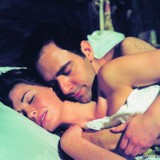
In this context, Nello a young and sensitive professor (Neri Marcorè) from Rome is sent to teach in a notable college in Bologna and most importantly to find a wife so he can eventually take over his father’s business. Nello falls head over heels with Angela (Vanessa Incontrada) – a stunning high society girl that due to an accident is blind.

This physical obstacle becomes a crucial “wall of protection” that temporarily keeps the relationship alive, albeit in two parallel worlds. What the eye can’t see, the heart can’t feel. Visual perceptions or their absence thereof lead the way. Yet, as soon as the handicap is removed social norms and family responsibilities forcefully reign in to keep order intact even at the price of losing one’s true love and career passion.

I also liked the score by Riz Ortolani of carefully prescient violins that effectively paint this fragile and doomed relationship every time the couple reaches another juncture in the ever-growing emotional imbalance.

>Buy this film

Next »