Published by Shlomi Ron on 09 Aug 2007

Salvatore Giuliano (Francesco Rosi – 1962)
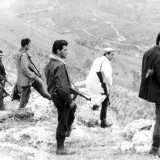
Salvatore Giuliano

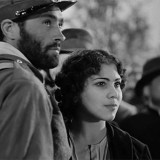
In this masterpiece classic director Francesco Rosi tells the story of Salvatore Giuliano, a famous Sicilian gangster that during the mid-40’s collaborated with a Sicilian separatist group, Movement for the Independence of Sicily (MIS), with close ties to the Mafia engaging with small-scale attacks on government and police targets.

Rosi delivers a poignant documentary that whisks viewers back and forth in time – the superiority of Giuliano’s gang over the police (carabinieri) and later depicting his funeral and court sessions. Interestingly enough, Rosi does not provide us with direct first person dialogs from Giuliano, we learn a lot about him through his friends and the results of his actions.

The real villagers of Montelepre – that helped Giuliano - provide a deeper sense of credibility for the narrative, largely because in essence they renact the true events they experienced first hand. A most memorable scene, is the crying women dash towards the carabinieri after learning that their arrested husbands – suspected of collaborating with Giuliano - are about to be transferred to Palermo. The sheer emotional force of this clash that illusrates the immense power of the immediate family circle and the village strong solidarity - is profound.

Salvatore Giuliano

The film is also about the importance of commuication with its diverse manifestations. We hear Giuliano’s gang whistling on hill tops to alert the arrival of the carabinieri, we hear the village drummer announcing the latest curfew orders, the village women spreading the word about the fate of their husbands, and the court sessions where conflicted interests play out the evidence about the responsibles for the massacre at Portella Della Ginestra.

The soundtrack by Piero Piccioni provides a charged suspense ambience that minimalistically supports the dramatic events that unfold, leaving ample space for the natural sounds and the occasional voice over to carry most of the emotional direction.

Gaspare Pisciotta (Giuliano’s deputy), played skillfully by Frank Wolff (postwar trend of many Italian directors to use American actors), demonstrates the transition of Pisciotta from being Giuliano’s most dedicated right hand into a collaborator with the carabinieri. As the social environment is rapidly evolving with conflicting interests surfacing either by historical events, mafia pressures, bandit alliances, carabinieri, family and community – are constantly pushing protagonists to optimize stances.

>Rent this film from Netflix - Only $4.99 a month!

>Buy this film

Published by Laura Bianconcini on 25 Jun 2007

The Three Brothers - I tre fratelli (Francesco Rosi 1981)

tre fratelli

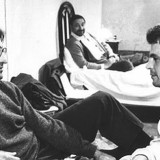
The mother’s death gathers together the three brothers back to their youth home.
Raffaele (Philip Noiret), the oldest, a successful famous judge, from Rome. Nicola (Michele Placido), a blue collar active in the union movement, dealing with his marriage crisis. Rocco, reserved and spontaneous, dedicated to help children in a correctional institute.

Donato, their father, a sweet old man, lined by a peasant life, simple and sincere. He called his boys for their mother’s funeral. So the three of them meet again after a long time in their old family house, where each one has something to recall.

We are in the south of Italy, in a dry flat infinite silent plateau. The house in white lime surrounded by the typical dry-stone walls. The faithful dog follows the old man around the desert courtyard. The windows are closed, because of the mourning. What a charming scene of solitude and sorrow, where feelings come out from things, and not from people. Even when we enter inside the room. The body is exposed to the care of the old black-dressed ladies who slowly and rhythmically repeat the proper litanies, with no interruption and no hesitation. A sound that is a melody, a melody that enchants and invites to indulge in ancient thoughts.

After quickly briefing about their lives, which is just an excuse for the director to introduce the nature of the characters, the three brothers reveal themselves during the night spent in the old large bedroom, with the light on, waiting for the funeral the morning after.

A moment of solitary, common meditation. An opportunity of comparison between who they were and who they are. An occasion of freedom, to face their fears or their wishes. With an awareness that is half way between the oneiric and the real.

But the dream of the father is different, it is the only dream that is about the past, real or not real, it is not important. He is with his young wife on the beach and suddenly, by playing with the sand she loses her wedding ring, Donato promises that they won’t leave without finding it, and the will. They find it. It’s a simple fact. The symbol of their simple love, their simple life. The only really important thing in their life, the promise of their love. How simple things were before.

A strong contrast with the ‘anni di piombo’ the years of terrorism, where young Italians are lost taking a political or a social position, culturally demanded to but intimately unprepared.

Well, the question is – like in the bar – do I have to be part of the social demand or I have to keep thinking about my private life? I don’t find an answer, as usual, but I do think that being part of a social movement, following a political ideal, is often a refuge to those who have lost their personal life track.

The final scene is the best. Donato, the old man, sees his wife’s wedding ring and slips it on his finger, next to his. Despite his loss, he seems relieved to have found himself back on track.

Find yourself wherever you are.

>Buy this film

Published by Shlomi Ron on 25 May 2007

Christ Stopped At Eboli - Cristo si è Fermato a Eboli (Francesco Rosi - 1979)

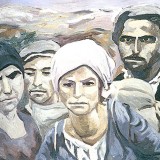
In this film, Francesco Rosi tells the story of painter Carlo Levi, an anti-fascist activist that was arrested in Turin in 1935 and was sent by Mussolini to the remote town of Gagliano (invented name) - in what is known today as Basilicata.

Christ stopped at Eboli

If you ignore the historical context of this film and focus on the quaint ambiance of a small village in Sicily, where old customs never changed in the past 3000 years – then you’re in for a remarkable journey into Italian peasantry culture.

The film vividly depicts the interactions of Levi (Gian Maria Volontè) with the locals from a perspective of an outsider, which is nicely aligned with viewers watching the film. The camera work is superb, inquisitively exploring the village and its people, while applying layered natural textures. If you look closely you’ll notice the intricate tapestry of objects and people that if paused would appear as a timeless oil painting.

I especially liked the dinner scene when Levi meets the local tax collector who vehemently shares the woes of his job collecting tax from the poor peasants. His only salvation is playing the clarinet. You can clearly identify with him and the burden of his “thankless job.” It’s a solid presentation of humanity and compassion.

Pierro Piccioni, Rosi’s long-time collaborator, provides a tantalizing soundtrack that explores the vast boundaries of the timeless existence of peasant culture compared to the modern world Levi is coming from. You can clearly feel the wide expanse of time and space and the futility in trying to bridge the two worlds. Listen to a fine sample here and you’ll hear what I mean.

In case you wondered, the film’s title “Christ Stopped at Eboli” is in fact an Italian expression to convey that old ways and belief system held by the villagers are stronger than their Christianity.

>Rent this film from Netflix - Only $4.99 a month!

>Buy this film

Published by Shlomi Ron on 27 Jan 2007

Hands over the City - Le Mani Sulla Città (Francesco Rosi - 1963)

Hands

The characters and events shown are imaginary
The social and environmental
context is real

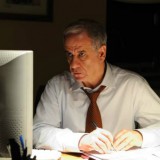
Fracesco Rosi’s outrageously bold social realism film ends with the above condemning statement. The film offers a unique over the shoulder view into the world of political deal making and corruption in Naples of the early 60’s. Rod Steiger effectively plays the ruthless, power-hungry real-estate speculator that successfully negotiates his way, disregarding needs of the people - in a scandal that has devastated Naples’s civilian landscape.

The film won the 1963 Venice Film Festival Golden Lion and vividly separates the bad guys from the good guys. However, beyond the obvious injustices, it offers a solid reality check. You start looking around you and gradually the picture becomes clearer. We’re all surrounded by outcomes good or bad that are nothing but a direct result of long influence chains of conflicting elements that somehow along the way aligned their interests and negotiated a deal or outcome. It could be your local shopping mall, interest rates, even this computer screen you’re staring at right now. It’s an outcome comprised of a long influence chain: chip suppliers, LCD manufacturer, computer maker, retailers and finally you the consumer - all operating with varying degrees of interests - to negotiate the best deal.

It could have been great if our world had unlimited resources and you could pretty much do anything you like with no consequences on others. Put simply, no losers only winners. Maybe someday when we can completely digitize our physical existence and create a virtual world where you can have endless digital copies of vital resources. Forget Web 2.0, Web millennium anyone? But then again you might say this could be a lonely and somewhat retarded world with no challenges where innovation is stifled.

Nice vision…until then we not only have to play with what we have, but also find ways to do it optimally. Enter Social Economics. The scientific study of the choices made by individuals and societies in regard to the alternative uses of scarce resources, which are employed to satisfy wants. Rosi’s pessimistic view shows how real estate choices in his beloved Naples are ransacked by political and business influence chains, which work only to satisfy their greedy wants. And Piero Piccioni’s erratic music does a superb job to support this premise.

To some extent Rosi’s message is still pertinent today. That said, these days wer’e all part of interconnected social and professional networks with new means of making a bottom-up impact. What influence chains are you playing with and for what outcomes?

>Rent this film from Netflix - Only $4.99 a month!

>Buy this film