Archive for February, 2007

Published by Shlomi Ron on 26 Feb 2007

The Escort - La Scorta (Ricky Tognazzi - 1993)

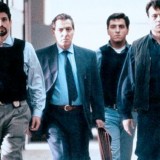
Ricky Tognazzi’s classic anti-mafia thriller is deeply grounded in reality. The film was made a year after judge Giovanni Falcone was murdered as he was on his way to Palermo airport. The judge, his wife, and three police bodyguards were killed. Interestingly the film is not about the judge or the case, but focuses on the four bodyguards and the close bonding they develop with his replacement prosecutor, an outsider sent from Rome strange to the Sicilian ways.

La ScortaYou might expect a fast-paced movie with lots of action, but then again you’re in for another surprise. The film manages a restrained undercurrent tension that causes you to believe that any second something radical is about to happen as the bodyguards face threats on the road shuttling the investigator back and forth in his quest to seek justice. However, for the most part nothing major happens as the plot zigzaging leaves you with a constant “that was close” sensation. I would say it’s probably a much accurate capture of bodyguard reality than the typical 90-minutes of endless pyrotechnics.

If you are also a fan of Ennio Morricone, you’re in for a treat. Not yet? Well, you definitely should be. Morricone, this year’s winner of the Honorary Oscar award for lifetime achievement, provides a pounding score. The music perfectly supports this mounting tension that hits the bodyguards externally as they dodge various dangers on the job, and internally with the strain it brings on their families.

The message is simple. If you look around you, you too can see that often the real heroes are not necessarily those prime time figures busy rescuing the world. It’s in fact their support teams those faceless helpers behind the scenes that carry the heavy load. And as we know these so-called margins are far more interesting than the center as the neorelaist film movement has proven time and again. Real stories of real people that with recent waves of reality TV shows and YouTube’s user generated media - are now back in vogue.

>Buy this film

Published by Laura Bianconcini on 21 Feb 2007

Special Interview with Director Mimmo Calopresti at Grand Opening of Los Angeles-Italia Film Festival
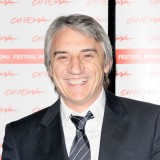
LA-Italia Film, Fashion & Art Festival

We enter the VIP lounge and start a fight for the food. The buffet is overcrowded, as it’s already 10pm. Hands grabbing us from every side like uncontrollable tentacles, hard to keep away, so I decide to hit the bar and get some wine, leaving Shlomi and Odelia to the food mission.

After drinking some wine and getting some food, we start looking around. Small groups of Italians spread here and there, with their unmistakable natural pop-star attitude, which make them, by definition, charming. A little loud, happy and totally unaware of American customs, they smoke more or less everywhere. Spontaneously charming I would say.

Our goal is to interview Mario Monicelli, that would be Shlomi’s dream-come true, one of the classic masters of Italian cinema. Unfortunately he’s secluded on a corner, between a protective assistant and a giant bodyguard. Although the informal environment would allow us to approach him pretty easily, after looking his sweet old look, I don’t feel like disturbing him, clearly immersed in a contemplative personal silence, out of the crowd.

We look around. Tony Renis, no. He really is not part of our plans. Franco Nero, famous Italian actor, well-known for his spaghetti western movies. Father of Carlo Gabriel Nero, the director of the last movie of tonight with Vanessa Redgrave (his mother), The Fever.
No, even him, with all our respect, does not meet our target.

Mimmo CaloprestiSuddenly I find myself next to Mimmo Calopresti, and this is almost like a coincidence. Why we didn’t think of him before? His early screening tonight – Volevo Solo Vivere (I Only Wanted to Live) is a documentary showcasing interviews with Italian holocaust survivors that were deported to Auschwitz.

Mimmo has an open smile, on a very Italian good-looking face. Italiano del sud, which makes him even more distinctive, more Mediterranean. He doesn’t speak English, or he doesn’t want to. So we decide to talk only in Italian, easier for me, more challenging for Shlomi.

He is an open person, towards the people. Respectful. His eyes move around quickly, however there is something that makes me notice his deep attention to everything, to any ordinary thing. Maybe it’s his bloodhound nose. It’s fun and interesting having Mimmo’s attention and kindness, in a quieter corner.

We ask Mimmo some questions about the movie we just saw. The following details what we got from Mimmo’s interview at the the bar and from a short Q&A on stage after the screening.

QIt’s a strong theme, why did you choose it?
A – Because since I studied this at school, I have been always interested in understanding what happened. However, the question that never left me was WHY this happened. I have tried to find an answer, even through this work, but I didn’t. I didn’t find any answer to this question. The only thing, important thing, is that from all of this we have to learn to prevent anything like this, from happening again. We must not forget.

QHow did you choose the interviews, based on what?
A – I chose those that I felt to be the most emotional to me. Those that touched me the most.

QHave you ever been to Israel?
A– Yes I did. I have also been to Auschwitz. I went with Walter Veltroni (the mayor of Rome), who every year takes students there from different schools. Once I went with them, it was a very strong experience.

QWhy a documentary?
A – To be precise, I actually started my career as a documentary director. I have done other documentaries in fact. I have always been interested in social topics.

QAnd what about your next work?
A– My next work is a fiction; we have just finished shooting it. It’s called L’Abbuffata – The Pigout.

Not knowing his previous works, our questions must end. We thank Mimmo and let him go to his friends. While we promise ourselves to watch his movies. And of course, review them!

More information about the work of Mimmo Calopresti from Repubblica
Mimmo Calopresti was born in Calabria, the region on the point of the boot. He lived in Torino for many years and here is where he started his job. He makes his first documentary A proposito di sbavature in 1985, followed by Alla Fiat era cosi’ (1990), a series of interviews to some ex blue-collar working in Fiat during 1969 when the social and political revolutionary movement wrapped Italy. Then, his first fiction interpreted by Nanni Moretti, La Seconda Volta– The Second Time in 1995. Set up in the tidy Torino, Mimmo Calopresti tells us with a great courage of words the terrorism of those times. It is a success recognized inside and outside the country. With La Parola Amore Esiste– The Word Love Exists (1998) he goes to Rome to set up the story of a cello teacher (Fabrizio Bentivoglio) and a weird beautiful girl (Valeria Bruni Tedeschi). The confirmation of his original style makes this work remarkable in several international festivals. In Preferisco il rumore del mare – I prefer the noise of the sea (2000) he is also actor, next to main character interpreted by Silvio Orlando. La felicita’ non costa niente- Happyness doesn’t cost anything, is from 2002. Mimmo Calopresti, tells about people who attempt to live with their personal contradictions, conscious of the urgency of making a choice and of its probable consequent mistakes.

Published by Shlomi Ron on 17 Feb 2007

The Fiancés - I Fidanzati (Ermanno Olmi - 1963)

Do your memories carry a soundtrack?

Ermanno Olmi in a genuine masterpiece believes they sure do. And why not? We all tend to associate old songs to places and people we used to know and this way create more vivid and richer “mini-episodes” in our mind. Olmi skillfully uses a lively tune of a dance hall where the two protagonists had met as a sleek time machine to whisk viewers back and forth between present, past and even imagined future.

The story takes place during the Economic Boom (Boom Economico) of the early 60’s in Italy, a period characterized by a transition from agricultural to industrial society. In this sense, Olmi continues with his displacement theme from Il Posto he did just two years earlier. If Il Posto tells the story of a young guy commuting from the province to the big city, in this film the transition is far more radical. It’s the experience of uprooting a factory worker from Milan all the way down to the industrial plants in Sicily, showcasing technological innovation planted in otherwise underdeveloped south, and the straining impact it brings on the relationship with his fiancé.

i fidanzati

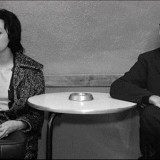
What does this picture tell you?

Yep, it’s pretty obvious to see the clear tension these two people have. On one hand Giovanni (Carlo Cabrini) sees the relocation as a great career opportunity, whereas Liliana (Anna Canzi) fears it will end their relationship. Back then most people were born, lived and died in the same place. The notion of finding work elsewhere was regarded as practically leaving all your life behind.

Ermanno’s signature style of minimal dialogs and maximum body language to convey a wide range of emotions is also prevalent here. My favorite is the opening sequence showing people entering the dance hall, checking out the crop of who showed up, finding their seats, the musicians getting ready on their post, the janitor surfacing the floor with white powder, the music begins, early dances breaking, and then the appearance of the two protagonists – solid first six minutes where words would have cluttered the clarity of depicting the place, the people and time. Simply exquisite!

>Buy this film