Published by Laura Bianconcini on 20 Oct 2007

Cinemasud - The First Italian Film Festival in San Diego

CinemasudCinemasud is now performing at the Museum of Photographic Arts in Balboa Park, San Diego.

A bit about the festival and its goals (description is from the Italian Cinema Sud site).

Cinema Sud, starting its worldwide tour with the screening of the documentary Détour De Seta at the Tribeca Film Festival in New York, has been organized by the Italian Ministry of Foreign Affairs in collaboration with AIP-FilmItalia.

It is an initiative supported by the funds of the programme Italia Internazionale, managed by the Directorate General for European Integration of the Italian Ministry of Foreign Affairs to support the internationalization process of southern Italian regions (Apulia, Basilicata, Calabria, Campania, Sardinia and Sicily).

Cinema Sud is carried out through the widespread activation of the diplomatic-consular network and the Institutes of Culture on the part of the Directorate General for Cultural Promotion and Cooperation.

In accordance with the six southern Italian regions, some films were selected because they were considered particularly significant not only for the promotion of southern Italian territory but also for their innovative contents and the wide range of cultural themes they dwell on.

Cinema Sud sets itself two goals: firstly, the enhancement of southern Italian territory and culture by showing very impressive images also portraying modernity and the changes occurred recently in Italy and in its South, in particular; secondly, the enhancement of Italian Cinema and of a generation of young authors from the South, who have been able to rediscover the new South in recent years, together with its traditions and millenary culture.

For more information, check the program at www.cinemasud.com

Published by Laura Bianconcini on 17 Oct 2007

From Cinemasud San Diego: My brother in-law - Mio Cognato (Alessandro Piva - 2003)

Friday October 11, 2007

Cinemasud discretely opens the doors. At the Museum of Photographic Arts of Balboa Park, we find all the organizers calm yet excited personally welcoming the guests.

Victor and his big smile impossible to miss. Black-dressed, he lost some weight I guess, maybe due to some insomnia and certainly a lot of work. Happy and thrilled ‘the movies are here’ he whispers relieved.

Giuseppe, impeccable, sober, professional. He politely thanks us for coming. Pasquale, friendly and discreet, overlooks the movement from his academic distance. (He is also tall).

Many people I know, we know, from many different networking, Italians and not. Some time spent complimenting, greeting and kissing (the Italian way). People are interested in the movies, and this is why we all came.

It is nice to have the organizers waiting for some latecomers. It’s cute.

The room is actually crowded and we have to hurry for three far seats. Yes, it definitely feels like being in a movie theatre watching Italian films. I think the last one in San Diego was La vita e’ bella. Well, no true, it was the beautiful Nuovomondo di Emanuele Crialese.

Grazie Victor, and everybody.

——–

Here is my impression about the first film shown - My Brother in-law - Mio Cognato (Alessandro Piva - 2003).

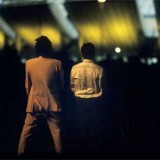
Mio cognato has been filmed in Bari, Puglia. The scene starts with the baptism of the son of Toni, ‘o professore’, an excellent interpretation by Sergio Rubini. The scene is strongly colorful but not neat. The place of the party is the empty terrace of a dreary restaurant facing the harbor of Bari. It is typical and tacky at the same time. It’s amazing how the typicality, the simplicity of people could mutate from being picturesque to sad and squalid in a different background. The suburbs of an Italian province, especially from the south, could be really desolate, and so its inhabitants.

However Toni o professore, in its yellow suit, black shirt and square ray-ban is so excessively tacky that could be even charming – at the Tarantino way.

my brother in law

It all starts when the car of Vito, his brother in law, gets stolen during the celebration. Toni is a magician of insurances, in the sense that he has an insurance business where policies if well managed could be very customizable. We don’t even know if the business exists for real, we only know that he is a professional in manipulating car or other insurance contracts. Of course in order to do that in a southern town you need to have the right connections.

Vito, Luigi Lo Cascio, is the young ordinary husband of Toni’s sister. Naïf style, he only wants to find his Opel Corsa, apparently the only thing really important, besides the fact that he was not chosen as the godfather of his nephew. This kind of things could be extremely crucial in the provincial life-style values.

The movie develops its story of small local criminality with Toni who tries to find Vito’s car through his special friends, discovering though that not too many friends are left in his risky relationships.

One night spent among quaint bad characters, improbable as well as real locations like la casa delle luci (the house of lights) a sort of street terrace illuminated like a funfair where all kinds of men spend the night playing ‘la morra’; the kitchen of a restaurant where Toni, waiting for one of his buddies, start preparing some spaghetti al nero di seppia (italian scale of values doesn’t change with circumstances); an ambulance-taxi to bring Vito to the emergency, after Toni smashed his nose in a moment of frustration.

It is a pot-pourri of tragic-comic situations and characters very well represented. Funny, excessive, bizarre and typical at the same time. The symbol of lemon that the mafia guys leave as a signature, is cute too.

Unfortunately Toni, o professore, unaware or stubborn to the truth, breaking the rules will bring the poor Vito to die. He was in the end more naïf than his brother-in-law.

YouTube Preview Image

Published by Shlomi Ron on 11 Oct 2007

Golden Door - Nuovomondo (Emanuele Crialese - 2006)

YouTube Preview Image

The latest film by director Emanuele Crialese (who also did 2002 Respiro) is a fine example of modern Italian cinema at its best - amazing photography, supported by clever screenplay and pounding soundtrack that will keep you relishing the experience days after watching.

The film vividly tells the story of Italian emigration to America through the Mancuso family, traveling from a small village in Sicily aboard a rocky ship, and their screening process on Ellis Island, extenuating the cultural differences of the old world with the rigid, at times preposterous requirements - of the new world. Beyond health exams, immigrants have to go through intelligence tests as ignorance – in the eye of immigration officers - is perceived as another contagious epidemic that needs to be filtered out.

In this Italo-french co-production, the most prominent element is the striking visual photography by Agnès Godard who provides a unique blend of close-up angles and top views textures that offers a remarkably deeper and much richer experience.

golden door I especially liked the scene with a top view of a huge crowd of immigrants, you would think standing all together ready to board a ship, yet gradually this crowd slowly starts to part ways. In an instant, you comprehend that one group is on the ship and the other is in fact still standing on the dock. A phenomenal use of similar texture alignment to convey sensations of achievement by those who made it to the ship and the radical element of departure.

The major cast members you will recognize from 2002 Respiro; The father played beautifully by Salvatore (Vincenzo Amato), and his two sons Angelo (Francesco Casisa) and Pietro (Filippo Pucillo). To this team is added Luce, the English lady played by Charlotte Gainsbourg who Salvatore falls in love with during the voyage.

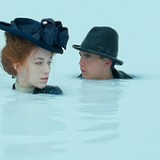
The film effectively illustrates the sense of confusion, struggle, and grand sacrifice immigrants had to go through in their quest for a better life in America. Interestingly, the director chooses not to show us completely how the immigrants interact with the new world outside, but limits our view to their symbolically perceived vision of America as river of milk. This provides another spectacular top view visual of immigrants swimming in that promised white liquid, each just a tiny blot paddling towards materializing their own dreams in the new world.

Why? Because they - we all deserve it!

>Rent this film from Netflix - Only $4.99 a month!

>Buy this film

Published by Shlomi Ron on 28 Sep 2007

Umberto D. (Vittorio De Sica – 1952)

umberto d

In one of the greatest accomplishments of the Neorealist film movement, Vittorio De Sica dedicates this film to his father and effectively captures the grim life of the elderly in post-war Italy.

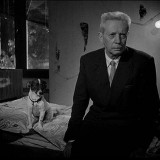
The film paints a vividly emotional picture of Umberto D. (Carlo Battisti non-proessional actor - a university professor from Florence), an older man in Rome who struggles to pay his landlady debts. His privacy and pride are constantly abused by people who simply don’t care; the ruthless landlady (Lina Gennari) tries to evict him by renovating his room during his absence, former work colleagues politely listen to his problem but then elegantly disappear.

His only support comes from two sources: the housemaid, Maria played beautifully by Maria-Pia Casilio, who tries to help as much as she can considering her precarious situation – upcoming pregnancy from unknown father and unclear job prospects once the landlady finds out.

umberto d

And then there is Umberto’s dog Flike that functions as the ultimate bastion of support and loyalty throughout his owner’s ordeal. The use of the dog is indeed the director’s radical condemnation to further emphasize the crush of all social systems, the lack of human solidarity and communication where only a dog can provide that unconditional compassion.

Beyond the grim ambience, I found a few whimsical moments that provides interesting time-parallels. Maria, the teenaged housemaid, invents her own SMS service to communicate with her soldier friends. To fill in for the probable cellphone ringtone, we hear the trumpet sound several times throughout the film, that drives Maria running to the window in Umberto’s room, where outside in the piazza, her soldier friends clumsily signal her, while reporting to their unit.

What I took from the film is simple; in our daily quest to conquer the world, human communication and solidarity should take a front seat.

>Rent this film from Netflix - Only $4.99 a month!

>Buy this film

« Prev - Next »