
Archive for the 'Drama' Category

Published by Laura Bianconcini on 06 Apr 2008

La destinazione – The destination (Pietro Sanna - 2003)

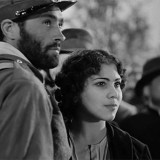
la destinazioneThrough the story of Emilio, a young carabiniere sent to a Sardinian village for its military training, the director Pietro Sanna gives us a picture of this culture that seems unchanged over the centuries.

Emilio comes from Emilia Romagna (region in the North of Italy, on the Riviera of Adriatic sea), and the only idea that he has of Sardinia is the hot tourist season during the summertime. However, once in Barbagia, the internal region of Sardinia probably the most remote, Emilio will face a totally different reality: bandits, bloodthirsty revenges, fear, psychological pressure, silence, resignation, mistrust.

This movie is about recalling the attention into a reality that is forgotten or even unknown to the rest of Italy. The Barbagia is renowned to be house to bandits, in the real meaning, since always. At the beginning of 1900 the Italian government sent forces to defeat the banditry, with some success, however without rooting out its culture. Because the banditry in Barbagia, in Sardinia, it’s a culture which derives from its anthropological history. Even if nowadays they are not that popular anymore and they are more threatened, some still exist and operate, because it is in their inner soul, in their ancestral instinct, is like a last attempt to preserve the species.

Furthermore, lifestyle changed very little, especially for those who work in the ship farming, where rules and laws keep ancient codes.

It is the nature, which remains hidden into a wild heart and in the harsh attitude that D.H. Laurence in its Sea and Sardinia book despite their black skirt and their white shirts with puffed sleeves sees the Sardinian man “so beautiful and stupendously masculine!”

“He walks with his hands behind the back, slow, straight, and detached. Wonderful untamable haughtiness… How beautiful the virility is when it finds its own expression!…”

Well, I just wanted to provide a small cultural background to suggest a deeper reading of such a society. However, a crime is a crime. Likely are very rare today.

For your information the director is a carabiniere in real life and is sardo as well. He was nominated for Donatello award 2004 as best new director.

Check my review of Ballo a tre passi, and watch the video to see the typical Sardinian costume, nowadays more rarely used.

YouTube Preview Image

Published by Shlomi Ron on 15 Mar 2008

Stromboli - Stromboli, Terra di Dio (Roberto Rossellini – 1950)

StromboliKnown as the father of the Neorealist film movement with his emblematic masterpiece Rome Open City – Roma Citta’ Aperta (1945), Roberto Rossellini in 1950 decides to change direction.

Seeing the role of cinema as mirroring a constantly evolving reality, he believes Italy has changed and there is no reason for producing more films about rough realities placed in bombarded cities. Italy in the early 1950’s is going through reconstruction that dramatically affects the fabric of society.

Hence, the rationale for moving away from Neorealism and towards what is known as the psychological human drama that focuses on the individual with themes of alienation, loneliness and more specifically of a woman who suffers. In other words, turning the ordinary story of the individual into the extraordinary.

Stromboli is part of this human trilogy that includes Europa 51’ (1952) and Voyage in Italy – Viaggio in Italia (1955). The trilogy is also known as “Ingrid Trilogy” because of the participation of Ingrid Bergman in all three films, a fact that in those days created a huge controversy both in Italy and the United States. It all started when Bergman at the peak of her career wrote a letter to Rossellini:

Dear Mr. Rossellini,

I saw your films Open City and Paisan, and enjoyed them very much. If you need a Swedish actress who speaks English very well, who has not forgotten her German, who is not very understandable in French, and who in Italian knows only “ti amo”, I am ready to come and make a film with you.

Ingrid Bergman (source: Wikipedia)

Shortly after they started working together on Stromboli and becoming a couple, each leaving their spouse and kids. Rossellini at the time was married to Anna Magnani – one of Italy’s leading actresses known for her passionate, down-to-earth roles. As a result Bergman was black listed for 7 years in Hollywood and Rossellini’s film was harshly criticized in Italy that saw this development as breaking a taboo. Interestingly, had this extramarital affair occured in the early 1960’s during the indulgent years of La Dolce Vita - reactions would have probably been milder.

In this context, the film tells the story of Karin (Ingrid Bergman) that as a way to escape a prisoners’ camp marries a fisherman, Antonio (Mario Vitale) who takes her to his home on the island of Stromboli. The island is part of the Aeolian islands and is portrayed as an island of hell battered by strong winds and frequent eruptions of a volcano that disrupts the lives of the villagers.

Into this reality Karin is brought to live and quickly she finds herself unable to adjust. She sees herself much more sophisticated then the locals and pragmatic as she is, she soon tries to escape the island.

The film follows Karin as she gradually sheds off her materialistic and opportunistic views of life facing the punishing forces of nature around her (hence the reason behind the title Stromboli - The land of God - Terra di Dio) – and the need to look for answers within herself instead of outside.

>Rent this film from Netflix - Only $4.99 a month!

>Buy this film

Published by Shlomi Ron on 26 Feb 2008

Bicycle Thieves - Ladri di biciclette (Vittorio De Sica – 1948)

Bicycle Thieves

Stories about the common man emphasizing social issues, scenes shot in actual locations, and the use of non-professional actors – are the key ingredients of the Neorealist film movement in postwar Italy, which this film is one of its prominent expressions.

Directed by Vittorio De Sica and adapted for the screen by Cesare Zavattini based loosely on the novel by Luigi Bartolini, the film tells a simple story. A man’s bicycle gets stolen and he looks for them. No wonder De Sica had difficulties to finance the film. You might say it’s a film about nothing.

Yet, there is so much more.

De Sica vividly paints a reality of dire economic conditions with consistent use of crowds in various contexts; fighting to get a job in the opening scene, in an endless line at the bus station, leaving a stadium, and waiting for a piece of bread at the church. Everything seems like a huge struggle. So against this backdrop of rough settings, even the sense of finally finding a job comes with a catch. Antonio, played beautifully by Lamberto Maggiorani, needs to have a bicycle in order to get the job. His wife (Lianella Carell) figures out a way to get back their pawned bicycle and off he goes on his first day on the job.

The scene of swarms of morning commuters either on bicycles, on foot or on overflowing buses pans nicely to Antonio’s facial expression of pride of being able to provide for his family – is very strong. Against all odds he overcame all obstacles and found a way to make a living.

Finding a job, and figuring out a way to keep it are key elements De Sica uses in order to substantiate the buildup of the accomplishment and the earth shattering sensation when this precious locomotive is being stolen the next day, thus crumbling Antonio’s aspirations for a better future. Emotions of deep haplessness and loneliness bring out powerful performances from father and son – two non-professional actors that could have probably experienced such predicaments in their personal lives.

Bicycle ThievesAntonio and his son Bruno (Enzo Staiola) are then thrown into an impossible quest of finding the bicycle somewhere around Rome. The father-son relationship throughout this journey is a rare examination of weighing priorities; finding the bicycles, the key to survival or recognizing the son’s needs as extenuated in the river scene.

The message of the film is clear. No matter how low you sink, the unconditional bonds you have with your loved ones should override any external threats.

>Rent this film from Netflix - Only $4.99 a month!

> Buy this film

Published by Shlomi Ron on 03 Feb 2008

Tickets (Ermanno Olmi, Abbas Kiarostami, Ken Loach - 2005)

You better leave now if you want to catch this train.

If we do a good job for this worldwide company, we’ll be on the gravy train for more projects.

Sorry, for this class the train has already left the station - registration is over.

Thanks, but you’ve just interrupted my train of thoughts.

ticketsTrains offer a rich canvas for conveying many human contexts, challenges, disappointments and hopes. So it’s only natural that cinema would utilize this eclectic locomotive in various ways. And indeed, trains and train stations play a highly emotional role in Italian cinema and beyond. The dramatic sense of departure between loved ones towards the unknown future (I Vitelloni, Federico Fellini - 1953), the arrival to a new place and the constant search for the ever-waiting relative (Rocco and his Brothers – Luchino Visconti - 1960) – and many more.

Whereas in most films the train environment appears only in a few scenes to underscore a particular emotional development, then in this film the train is brought front and center and functions as the constant backdrop for the plot throughout the whole film.

Moreover, this film provide a cross-cultural triptych of three prominent directors;tickets Ermanno Olmi (Italy), Abbas Kiarostami (Iran), and Ken Loach (Britain). Each brings his own artistic sensibilities to weave a story with characters riding the train from central Europe to Rome. The beauty of the film is how these characters transition from one story driven by one director to another. For that matter, it’s definitely worth viewing the Behind the Scenes bonus content to appreciate the careful planning that was involved in weaving these three independent plots into one cohesive artwork.

Often trains’ linear nature represent a metaphor for life’s winding rail where each station is another milestone en route to a final destination, that once accomplished nirvana supposedly descends. The same logic is also apparent in this film where Olmi, leveraging his signature style of using present to past flashbacks (see The Enagaged - I Fidanzati – 1963), Kiarostami by creating a somber brooding mood about past events and Loach by planting series of human miscommunications that unravel upon arrival to Rome.

No doubt, trains are vibrant microcosms where ephemeral human stories are produced every day. Think about it the next time you ride the train…

>Rent this film from Netflix - Only $4.99 a month!

>Buy this film

« Prev - Next »